
Showing posts with label secretary bird. Show all posts
Showing posts with label secretary bird. Show all posts
10 May 2013
Soggy secretary bird
It was a cold and rainy day at Addo, but we went anyway. And as we soon discovered you are never disappointed when visiting the park, because there is always something to see. This secretary bird was very intent on foraging in the pouring rain and has made an interesting study with its wet feathers and the rain "streaking" in the background.


28 November 2007
S for Secretary Birds
One of the things I love about Africa is the variety of wildlife. It is a great thrill when driving on the open road to come across a Secretary Bird roaming the savannah. These pictures were taken a few years ago at the Mountain Zebra National Park, with a point and shoot camera and are not of the best quality.

Secretary Birds are recognizable by having an eagle-like body on long crane-like legs, which increases the bird’s height to around 1.3 m (4 ft) tall. It has an eagle-like head with a hooked bill, but has rounded wings. Body weight averages at about 3.3 kg (7.3 lbs) and the wingspan is over 2 m (6.6 ft).
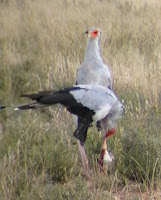

Secretary Birds are endemic to Sub-Saharan Africa and are non-migratory. They prefer open grasslands and savannas rather than forests and dense shrubbery. They roost on the local Acacia trees at night and they spend much of the day on the ground, returning to roosting sites just before dark.


The Secretary Bird is largely terrestrial, hunting its prey on foot. Adults hunt in pairs and sometimes as loose familial flocks, stalking through the habitat with long strides. Prey consists of insects, small mammals, lizards, snakes, young birds, bird eggs, and sometimes dead animals killed in brush fires.


Secretary Birds have two distinct feeding strategies. They can either catch their prey by chasing it and striking with the bill, or by stamping on their prey until it is stunned or unconscious enough to swallow

Secretary Birds are monogamous. Their nests are built on top of Acacia trees, usually 5-7 m (15-20 feet) high. The nest is around 2.5 m (eight feet) wide and 30 cm (one foot) deep, and is constructed as a relatively flat basin of sticks.
Subscribe to:
Posts (Atom)


