Showing posts sorted by relevance for query dung. Sort by date Show all posts

01 December 2008

Ecological day - Flightless dung beetles

Dung Beetles are found all over South African and perform a vital cleaning up job, even if they do not realise it themselves. Not exactly a job I would like, but then I was not born into it.


The Addo Flightless Dung Beetle only occurs in the Eastern Cape Province, in a small area, but it is fairly common within it's range. This terrestrial invertebrate occurs in habitats such as the Fish River scrub and Spekboomveld. They often congregate in 100's in the Addo Elephant National Park, which is the best place to see these special beetles.

The dung beetle is a member of the families Bolboceratidae and Scarabaeidae.

It is quite common within it's very restricted distribution and range, mostly in the main game area of the Addo Elephant National Park, but it also occurs in the rest of the Greater Addo National Park.

The dung beetle has right of way on the roads, but are often driven over by careless motorists.


The Addo Flightless Dung Beetle adults gather at African Elephant dung for feeding and at Cape Buffalo dung for feeding and breeding.


These insects shape the dung into large round balls, which are then rolled away to be buried. See Port Elizabeth Daily Photo for more pics.


The dung beetles only nest once a year and in this time period they produce only one young beetle. Their conservation status is vulnerable as they depend on 2 large herbivores for survival: Elephant and Buffalo, of which there are fortunately plenty in the Addo Elephant National Park.


For more on Ecological Day visit Sonia at Leaves of Grass.

31 May 2014

Bling and dung

Since I am on the subject of dung, here are a few more "citizens" of the bush that find it just to their liking. This just goes to show that very little is left to go to waste in the bush - eventually the dung will break down and return to the soil as essential nutrients - but while it is still lying about, some creature will find a use for it.

At a certain time of the year (January and February) the Park is swarming with Brown-veined White Butterflies when they start their migration from the drier parts of the country to the more moist regions. Though moisture is not a problem for them in Addo, as long as there is fresh elephant dung lying about.


This Cape Glossy Starling, aka Bling Bird, is looking to see what delights it can find in a pile of elephant dung. In case you are wondering about the bling, click here for the origins.

30 May 2014

The gentle art of the flightless dung beetle

When you drive around the Addo Elephant National Park there are signs on the road warning that the dung beetles have the right of way and you had better believe it.  They are often seen scurrying along the road looking for nice fresh piles of elephant or buffalo dung to make their balls.


It was interesting watching this guy make his dung ball from scratch, carefully breaking off pieces of dung and compacting them into the right shape.


King of his "castle"


If you want more information on these fascinating creatures click here for a post I did on them in 2008.

05 May 2008

Lesotho - first impressions

We entered the Mountain Kingdom of Lesotho in the Southwest, at Tele Bridge, which borders on to the Eastern Cape. It is there that we first saw that Lesotho is a totally different world, to our own country that co,letely surrounds it and I guess, fell in love with the land and its people.


One similarity though is the taxis - when it comes to speeding and stopping in awkward places we are on a par - though I will be bold enough to say that ours are probably worse than theirs, when it comes to aggression.


As you start climbing from the river valley at Tele Bridge you see the first of many huts, probably very similar the the early stone structures. The older ones have walls built of beautifully dressed sandstone, while the inside walls are plastered with a mixture of clay and cow dung. Where corrugated iron has replaced thatch the roof sheets are held down with rocks, to prevent them from blowing off in the high winds that sweep through the country.


Taxis are an important mode of transport in the country - other than donkeys, horses, wheel barrows and of course feet.


The land is badly eroded eroded from over grazing. Wherever you go, whether in the river valleys or on the highest peaks, you will come across herdmen looking after their livestock.


We found that the people are warm and friendly. Wherever we went someone was smiling and waving at us as we drove past. Here a couple of women are headed home with firewood they have just collected.


Many of the Basotho people still wrap themselves in their traditional blankets when going out during the day, a custom that is unique to the Basothu.

The village of Mt Moorosi was organised chaos. Music blaring from radios, traders selling their wares and shoppers looking for a bargain. Believe it or not this is a main road - no wonder the speed limit through the towns is 50 kph.

If you happen to miss the speed limit sign, which is quite possible as there often aren't any, you may hit a rather nasty speed hump in the middle of the road, if you are not careful. As you will see in the picture below they are also not well marked.

The road to Mount Moorosi, where we spent our first two nights, followed the Senqu (Orange) River as it wound its way through rather hilly country.


Journey's end on day one was Mount Moorosi, which was the scene of an epic nine month seige and battle between the the Baputhi tribe and the British forces in 1879. It is a heroic and tragic story that I will be covering in a later post.

15 September 2007

A load of bull and and a load of innocence

Back in the days when it was not done to talk about “the birds and the bees’, in polite company or heaven forbid tell you children about these deep dark secrets, grandpa and uncle Stanley strolled down to the cattle kraal (pen, corral). They were accompanied by Aunt Molly, who at that time was a naïve teenager.

It was dip day. Once a month all the cattle were rounded up and brought in to be dipped and examined for injuries or diseases.

Dip day was always one of the highlights on the farm, with all the hustle, bustle and activity. There is always a lot of dust and noise from the cattle milling about and bellowing. The herdsmen add to the general cacophony with their whistling and shouting and cracking of whips. Then there is the smell of fresh cow dung, mingled with the smell of the dip and the hordes of flies that feel obliged to grace you with their company.

You have to be a farmer to enjoy this. Grandpa generally carried his fly whisk. It was the end of a cows tail attached to a handle – gross but effective – which he used to fend off the flies, as they buzzed around his head.

The two gentlemen (actually they were rough, tough farmers born in the 19th century) and the young lady stood silently at the fence watching the activities. They were not the type of men to waste breath on unnecessary conversation.

After a while Uncle Stanley turned to his brother and said, “Nice bull Harry”.

Grandpa nodded and grunted his acknowledgement.

“How can you tell it is a bull?” asked Aunt Molly, sweetly.

“By the horns my dear, by the horns”, Uncle Stanley responded without hesitation.

“Oh”, said Aunt Molly, now none the wiser, “I never knew that”.


Some of grandpa's cattle in the bush. They eventaully became so wild and unruly that he stopped dipping them.
After many complaints from the authorities he invited the Animal Health Inspector to come and dip them one day. He took up the challenge, but his efforts were less than succesful and after nearly being gored to death, he stopped visiting grandpa's farm.
Grandpa's cattle were treated as game thereafter.

03 May 2008

Roughing it in the Mountain Kingdom

We have been without phones and internet for six days since leaving for Lesotho, so this is my first opportunity to do a post. Lesotho may be surrounded by South Africa, but it is very different from South Africa. In fact in most parts of the country, it is like going back in time.

Though my cell phone is on international roaming, I could only send sms's when there was a signal. Public phones are available though.

Did I say we were going to camp?


In the words of Arnold Schwarzenegger, "I lied". Not totally - we decided to go for variety. Looking at the wind swept camping site at Mt Moorosi we decided to try out the local accommodation - a stone built, thatched hut, with the internal walls plastered with a combination of mud and cow dung. In case you are wondering it does not stink, but creates a rather hard textured surface.


Suzi-k looking rather pleased with her abode for the next two nights. That's what it looked like before we filled it with our gear. It was a great experience, even though the matresses we a bit lumpy.

Greeting the dawn of a new day with a cup of hot coffee. By the way it was very cold up in the mountains - for those of us who come from a temperate coastal climate.


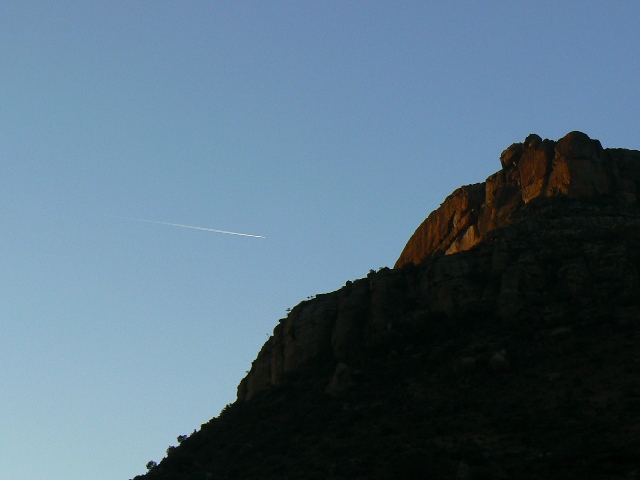
Even though we were in a remote area, with very little in the way of modern trappings, we were reminded of the big world that exists out there with the early morning "milk run" fron Durban to Port Elizabeth flying past.

We have so many interesting things to share about our experiences and life in the Mountain Kingdom of Lesotho and the journey up there, so watch this space and
Suzi-k's blog for more.